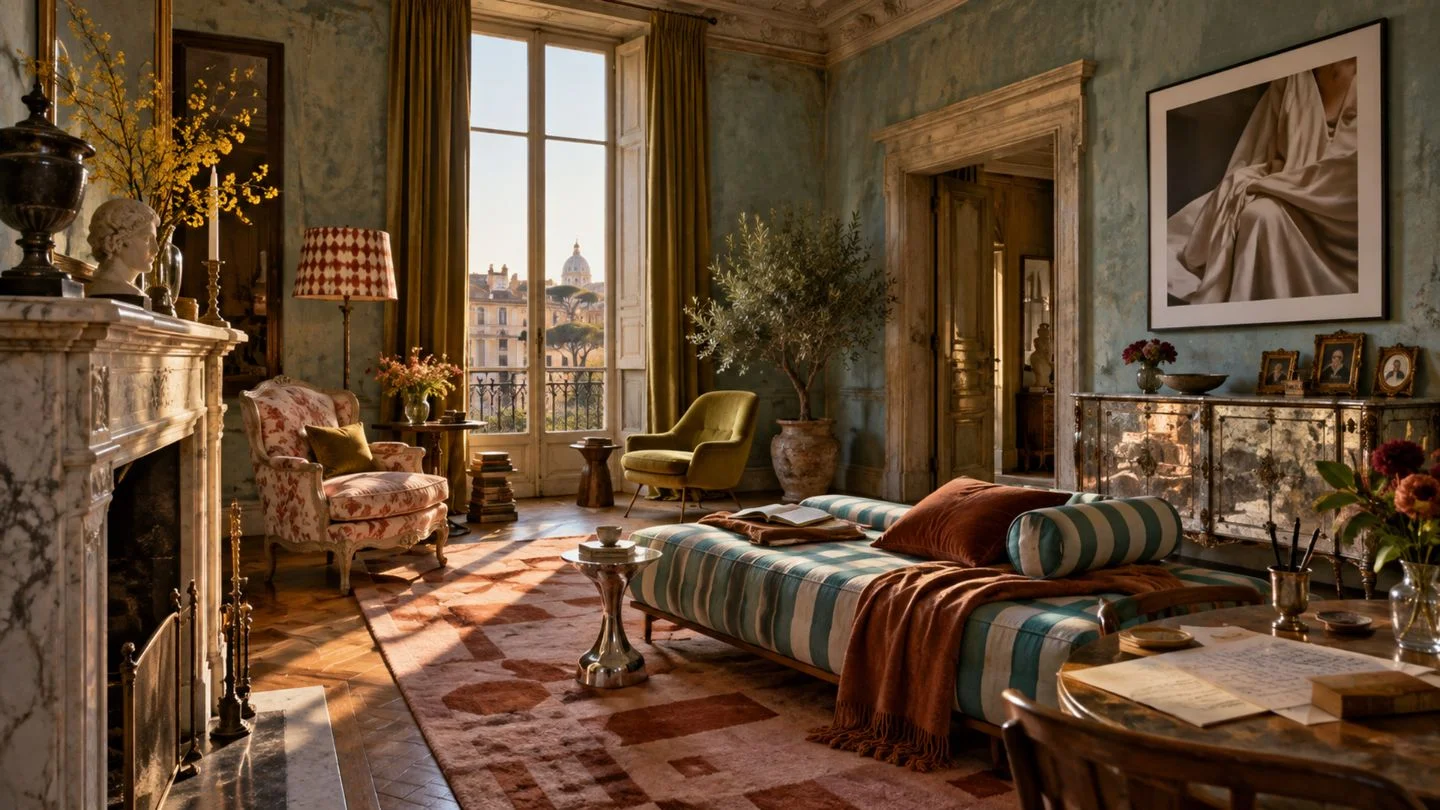
How architecture, color, pattern, art, and objects create rooms that feel historic, expressive, and deeply alive.
A historic Mediterranean room can hold centuries of architecture and still feel unfinished.
Stone vaults, timeworn floors, carved doors, and deep-set windows establish beauty, but architecture alone does not make a room feel inhabited. Without color, pattern, art, and the evidence of a discerning life, grandeur can remain emotionally distant.

Collected Mediterranean maximalism closes that distance.
It allows ancient architecture to meet contemporary art, important antiques, expressive textiles, and modern furniture without reducing the interior to a theme. The aim is not to recreate an idealized villa or fill every surface with Mediterranean motifs. It is to build a room with memory, tension, warmth, and enough confidence to hold pieces from different places and periods.
The most compelling version of this style is both abundant and ordered. Every layer has a role:
Architecture establishes the rhythm. Color shifts the atmosphere. Pattern creates conversation. Art changes the balance. Furniture turns monumental space into a setting for actual life.
These seven principles show how to create that richness while keeping the authority of the architecture intact.
1. Let the Architecture Establish the Order
Historic Mediterranean interiors already contain a visual grammar.
A barrel vault directs the eye. An arch marks a threshold. A deep window gathers shadow at the edge of a room. Worn limestone gives the floor weight, while plaster walls hold light differently as the day changes.
These features are not decorative background.
They are the first and most permanent layer of the composition.
The strongest rooms respond to those conditions instead of decorating around them. A curved sofa might follow the line of an apse. A reading chair can settle into the depth of a window rather than floating without purpose. A long table can reinforce the axis of a vaulted room, while a low cabinet allows an arched opening to remain visually dominant.
This does not mean every furnishing must mimic the building. In fact, literal repetition can make an interior feel staged.
The architecture should establish order, not dictate a costume.
Once its proportions, sightlines, and natural gathering places are understood, furniture and objects can introduce contrast without weakening the room.
The Design Principle
Architecture first. Decoration second.
Before adding another object, textile, or piece of furniture, ask what the room itself is already asking you to notice.
2. Use Color as a Counterpoint
Mediterranean interiors need not remain trapped in terracotta, brown, and cream.

Those tones may belong naturally to stone, timber, and clay, but a collected room becomes more expressive when color works as a counterpoint.
Cobalt sharpens warm limestone.
Coral brings movement to dark wood.
Aubergine gives a luminous room gravity without turning it gloomy.
Olive, saffron, chalky blue, and oxblood can feel equally at home when they are chosen in conversation with the existing materials.
Build a Palette with Hierarchy
A sophisticated palette usually has hierarchy:
- Let one color lead
- Use a second color to change the temperature
- Allow a third to appear briefly through art, upholstery, ceramics, or a single lampshade
This creates recurrence without making every element match.
The eye recognizes a relationship, but the room still feels discovered over time.
Color also changes how materials are perceived. A blue textile can make old timber feel warmer; a faded rose rug can make pale plaster seem cooler.
Before choosing a palette, notice what the architecture is already doing with light and shadow.
The right color does more than decorate a surface. It reveals something latent in the room.
3. Let Patterns Speak in Different Voices
Pattern should create conversation, not perfect coordination.
Broad stripes feel architectural.
Small florals soften their certainty.
Checks introduce order.
Antique rugs add irregularity, age, and visual depth.
The room becomes interesting when these voices remain distinct but still belong to the same larger composition.
Think About Scale Before Matching
Scale is often the most useful tool.
A botanical sofa can sit beside a checked chair when one pattern is generous and the other compact. A finely patterned rug can support a bold stripe because they do not compete at the same visual frequency.
Color may provide the connection, but contrast can be just as effective.
Concentrated moments are also more powerful than constant repetition. Embroidery might appear on one exceptional cushion. A patterned tile could define a single threshold rather than every wall.
When every textile is equally emphatic, the room loses rhythm.
When some patterns lead and others whisper, abundance becomes legible.
Matching can make everything feel newly purchased. A little tension makes the room feel collected.
4. Treat Art as Part of the Architecture
Art should not arrive as the final decorative layer.

In a collected Mediterranean interior, art changes the room’s balance.
One enormous painting can give an ancient wall a new center of gravity. A sequence of photographs can establish rhythm along a passage. Sculpture can occupy a stone niche without pretending to be historical, while a tapestry can soften a high room and hold its scale.
The most effective placement begins with proportion, rather than with a desire to fill empty walls.
A modest work may need an intimate corner where it can be seen at close range.
A large abstract painting can command a plaster wall precisely because its language differs from the architecture around it.
Old and new become more vivid in each other’s presence.
Not Every Wall Needs More
Collected maximalism does not mean covering every available wall.
Sometimes one significant work creates more richness than twenty unrelated frames.
The important question is not whether the art matches the sofa or repeats the room’s colors.
Ask instead:
Does the art change how the architecture is seen?
Good art adds a second intelligence to the space.
5. Create Tension Between Eras
A room made entirely from antiques can become reverent, as though nothing may be moved or touched.
A room made entirely from contemporary design can lose the memory carried by old walls.
Collected maximalism needs both.
Its energy comes from the exchange between eras rather than loyalty to one period.
An old cabinet brings patina and visual weight.
A sculptural Italian sofa moves the room forward.
A midcentury chair introduces a sharper line.
Contemporary lighting activates the distance between a historic ceiling and the furniture below.
These pieces do not need to share an era, country, or decorative label.
They need quality, proportion, and enough presence to stand beside stone, timber, and art.
Allow Some Contrasts to Remain Unexplained
Resist the urge to explain every contrast.
A modern chair in a centuries-old room does not need a matching modern console to justify it.
Let a few decisions remain singular.
That independence is what makes the interior feel personal rather than assembled from a formula.
6. Build Intimacy Inside the Grandeur
Monumental architecture becomes comfortable when the furniture stops trying to compete with it.
Two chairs beside a vast fireplace can feel more luxurious than a formal suite spread across the entire room.
A sofa beneath one arch creates shelter without closing the space.
A rug defines emotional territory.
Lamps lower the ceiling after sunset.
Books and a tray for coffee make the setting ready for life.
Design Around Rituals, Not Just Layouts
Think about what actually happens in the room.
Where will someone read in the afternoon?
Where can two people talk without raising their voices across the room?
Where does music sound best?
Where might dinner continue long after the plates are cleared?
These questions produce arrangements that feel specific, and specificity is often what gives a grand room warmth.
The architecture may be impressive, but comfort is created at the scale of the body: a chair within reach of a table, light falling where it is needed, fabric that invites touch, and a view framed from the place where someone actually sits.
Collected maximalism is not abundance for display.
It is abundance organized around use.
7. Edit Until the Abundance Becomes Legible
Maximalism loses its intelligence when every object asks for equal attention.
A collected room needs hierarchy.
The architecture, principal artwork, strongest textile, and most distinctive piece of furniture may carry the composition.
Smaller objects then create rhythm:
Ceramics repeat a color. Books soften a cabinet. A candlestick introduces height.
Editing Does Not Remove Personality
Editing is the act of making personality easier to understand.
If a surface feels crowded, begin by identifying the object that matters most.
Give it space.
Then return only the pieces that strengthen its scale, color, story, or use.
Moving an object to another room may reveal both rooms more clearly.
And remember:
Negative space is not the enemy of maximalism.
A quiet stretch of plaster allows a painting to hold the wall. A bare portion of tabletop makes a group of ceramics feel intentional. An unoccupied corner can deepen the sense of volume.
The room remains abundant, but the abundance gains cadence and meaning.
MORE ON MAXIMALISM
8 Dining Table Decor Ideas | Romantic Dark Academia Maximalism
Light Fixtures in Maximalism: A Softer Approach to Layered Light
How to Style a Maximalist Home Using Memories, Art, and Travel Objects
Collected Maximalism: The Art of Composed Intensity
12 Types of Maximalism in Interior Design — And How to Use Them Intentionally
Collected vs Curated in Maximalist Interiors: Is There a Difference?
The Psychology of Maximalism: Emotional Density in Layered Interiors
Minimal Maximalism: Abundance Within Restraint
The Maximalist Way to Shop: How to Collect with Intention
Maximalist Interior Design: Layering Texture, Form, and Warm Earth Tones
How to Create Visual Hierarchy in an Abundant Room
An abundant room does not need fewer things.
It needs a clear order of attention.
One of the reasons successful maximalist interiors feel composed rather than chaotic is that everything is not competing at the same visual volume. The eye understands what to notice first, what to discover second, and what to encounter only after spending time in the room.
Think of the composition in three levels: dominant, secondary, and tertiary.
1. Dominant: Let the Architecture Hold the Room
In a heritage interior, the dominant layer often already exists.
A vaulted ceiling, carved stone fireplace, dramatic archway, patterned floor, fresco, or pair of monumental windows may carry more visual authority than anything you could add.
Let it.
The architecture should establish the room’s largest gestures—its scale, rhythm, movement, and sense of permanence.
This does not mean leaving historic rooms sparsely furnished. It means understanding that abundance becomes more powerful when it has something substantial to organize itself around.
The dominant layer gives the eye somewhere to begin.
2. Secondary: Use Art and Furniture to Create Conversation
Once the architecture establishes order, art and furniture can begin to challenge it.
An oversized contemporary painting against old plaster. A sculptural sofa beneath a traditional ceiling. An antique cabinet beside a modern chair.
These secondary elements should have enough presence to stand confidently within the architecture without attempting to overpower it.
This is often where the personality of a collected interior becomes visible.
Architecture may belong to the history of the building. Art and furniture reveal the life being lived inside it now.
Choose a few pieces with real visual authority rather than asking every chair, table, painting, and textile to become a focal point.
3. Tertiary: Let Objects Reward a Closer Look
The final layer operates at a more intimate scale.
Books stacked beneath a lamp.
A small bronze sculpture.
Ceramics gathered on an old table.
A textile folded over the arm of a chair.
Candlesticks, framed sketches, bowls, boxes, flowers, and objects brought home from travel.
These details create the feeling that a room has been accumulated rather than installed.
But tertiary objects should remain tertiary.
When every tabletop is crowded and every small object demands attention, the hierarchy collapses. Instead, group objects into moments and allow quieter areas between them.
The reward of an abundant room should be gradual discovery.
The Three-Level Hierarchy
A useful way to read the room is:
Dominant — Architecture
Establishes scale, rhythm, and order.
Secondary — Art + Furniture
Introduces personality, contrast, color, and tension.
Tertiary — Objects + Details
Adds intimacy, memory, and evidence of life.
Not every room will follow these proportions literally. An extraordinary artwork may become dominant. In another room, a monumental antique might take that role.
What matters is that something leads, something supports, and something rewards closer attention.
This is where visual hierarchy becomes especially important in collected maximalism.
The goal is not to reduce abundance until the room becomes quiet.
It is to organize abundance so the eye can move through it.
From architecture, to art, to furniture, to the smallest collected object, each layer can reveal itself at a different pace.
A richly layered room does not have to tell you everything at once.
Its depth comes from giving you a reason to keep looking.
A Room That Holds More Than One Time
Collected Mediterranean maximalism is ultimately a relationship across time.
Old stone gains energy beside contemporary art.
Pattern feels sophisticated when rhythm replaces matching.
Antiques remain alive when modern pieces challenge their formality.
Grand rooms become generous when they are arranged around the rituals of everyday life.
The result is layered without becoming chaotic, historic without becoming frozen, and expressive without losing restraint.
It does not rely on a checklist of Mediterranean symbols.
Its authority comes from attention: to proportion, material, light, use, and the emotional charge created when unlike things are placed together with conviction.
Begin with what the room already knows.
Follow the architecture. Introduce color that changes its atmosphere. Allow each new layer to earn its place.
A collected interior is not completed in a single shopping trip.
It grows through looking, living, editing, and returning.
And that slowness is not a limitation.
It is what gives the room a life beyond style.
Subscribe to Collected Maximalism for more interiors shaped by art, history, pattern, and the enduring pleasure of a home gathered slowly.


