Introduction
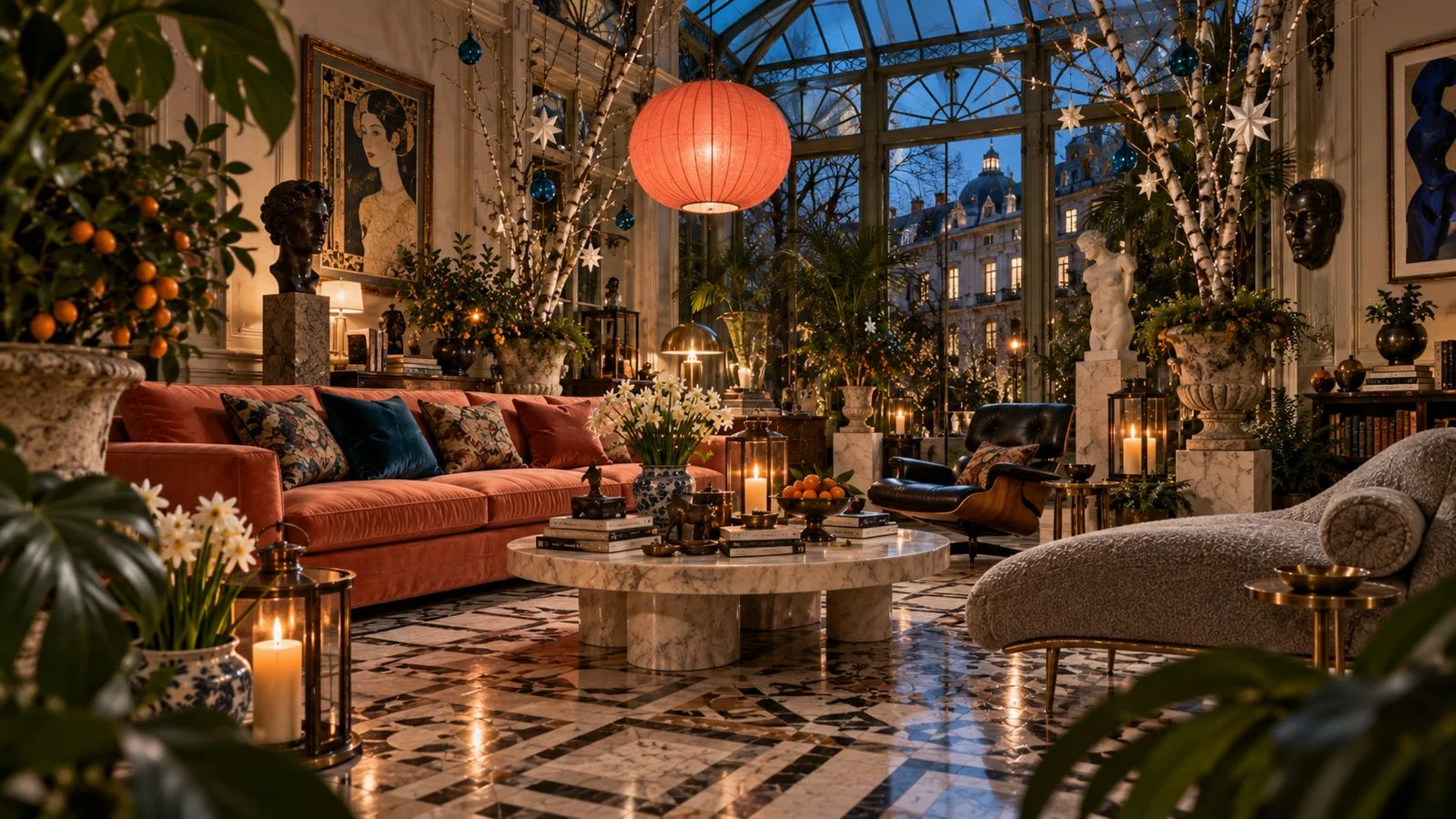
Some Christmas rooms appear newly decorated. Others feel as though the season has returned to them for generations.
The distinction is not necessarily found in a taller tree, a fuller garland, or a more elaborate collection of ornaments. It is found in the relationship between the decorations and the life already present in the room. Paintings retain their authority. Books remain within reach. Antique furniture, patterned textiles, old porcelain, and familiar objects continue to shape the atmosphere.
Christmas enters this existing composition as another layer.

This is the enduring appeal of European Christmas decor. Rather than transforming a home into a temporary holiday setting, it allows the season to settle into the rooms with grace. Greenery follows the architecture. Candlelight deepens the colors of old wood and velvet. Ornaments appear collected rather than coordinated. The house remains recognizably itself, only warmer, richer, and more ceremonial.
These seven decorating principles can help create that same sense of history and atmosphere, even in a home without centuries-old architecture.
1. Let the Room Remain the Main Character
The room should still feel like itself after Christmas arrives.
In a collected interior, the existing paintings, books, rugs, furniture, and decorative objects are not cleared away to make room for holiday decor. They become part of it. A bowl of winter fruit can sit beside a stack of books. Greenery may soften the base of a portrait. A length of velvet ribbon can introduce seasonal color against the grain of an antique cabinet.
Begin by studying what already gives the room its identity. It might be the weight of a dark bookcase, the faded reds in a Persian rug, the shape of a marble mantel, or the quiet gleam of gilt frames. Christmas decorations should strengthen these qualities rather than compete with them.
This approach also creates visual restraint. Even a richly layered room needs hierarchy. If every object announces Christmas at the same volume, the eye has nowhere to rest. Let the room lead, then add seasonal details where they can deepen its established character.
The tree should feel like part of the composition, not an unrelated centerpiece placed in front of it. Consider how its height, fullness, and position relate to the furniture, windows, and artwork around it.
A convincing Christmas room does not abandon its everyday life. It allows that life to become more luminous.
2. Decorate the Architecture
A mantel, doorway, staircase, or tall window naturally reveals where Christmas belongs.
European Christmas decorating often follows the architectural lines of the house. Greenery rests along mantel shelves, frames doorways, travels down banisters, and marks the thresholds between rooms. These gestures connect the decorations to the building itself, giving even temporary materials a sense of permanence.
Allow garlands to remain slightly loose. A branch extending beyond the edge of a mantel can feel more natural than an arrangement cut to perfect symmetry. Around a doorway, greenery may be fuller on one side, particularly when balanced by furniture, artwork, or a lamp on the other.

Windows offer another opportunity. A restrained wreath can be suspended against the glass, while candles placed nearby reflect after dark. Interior arches and paneled doors can carry ribbon or foliage without requiring elaborate installation.
If the home has limited architectural detail, identify its strongest structural features. A bookcase, tall mirror, console table, or substantial window can perform a similar role. The purpose is not to imitate a historic house. It is to make the decorations feel responsive to the room rather than scattered across it.
3. Build from an Inherited Color Palette
The richest Christmas palettes often look discovered rather than selected.

Look first at the colors already living in the room. Burgundy may appear in a rug or upholstered chair. Forest green might be present in velvet, painted woodwork, or the landscape within an old oil painting. Antique gold can be drawn from brass lamps and picture frames, while warm ivory, aged brown, and blue-and-white porcelain provide quieter notes.
Use these existing colors as the foundation of the Christmas scheme.
The palette does not need to match perfectly. In fact, slight variations create greater depth. Pair wine red with faded rose, evergreen with olive and moss, or polished brass with darker, timeworn metal. Bright white can feel abrupt in an old-world room, while ivory candles and creamy textiles sit more naturally beside aged wood and antique finishes.
Repetition matters more than exact coordination. A note of burgundy might travel from the rug to a velvet ribbon and then to the dining table through fruit or flowers. The eye recognizes the relationship without reading it as a formal color scheme.
This is what makes a palette feel inherited. It appears to have grown from the room over time.
4. Choose Ornaments That Suggest Memory
A collected Christmas tree should reward a closer look.
Instead of relying on a perfectly matched set, combine ornaments of different ages, materials, sizes, and visual weights. Glass baubles can mingle with velvet ribbon, framed miniatures, handmade decorations, dried fruit, small bells, and objects found during travels.
Not every piece needs to be conventionally seasonal. An antique brooch, tiny portrait, decorative tassel, or small silver object can become an ornament when attached thoughtfully. These unexpected elements give the tree a sense of biography.
Variation should still feel edited. Repeat a few materials or colors throughout the tree so that the arrangement retains visual rhythm. A recurring burgundy ribbon, aged gold finish, or warm glass ornament can unify otherwise individual pieces.
Leave enough space for important decorations to be seen. A collected tree is not necessarily an overcrowded tree. Its richness comes from the quality of the relationships between objects.
The aim is to suggest that each ornament arrived for a reason and that the collection is still evolving.
5. Use Natural Materials Imperfectly
Greenery feels most persuasive when it retains something of the garden.

Branches can bend. Garlands can fall unevenly. Leaves may face different directions. This looseness is especially effective in rooms filled with formal furniture, polished surfaces, and historic objects because it introduces movement.
Combine evergreen foliage with holly, berries, dried hydrangeas, herbs, pinecones, winter branches, or seed heads. Pears, pomegranates, figs, and citrus can bring color to mantels and dining tables without making the arrangement feel overtly themed.
The vessel matters. Natural materials take on a different character when placed in a silver bowl, stone urn, old ceramic jug, or blue-and-white porcelain pot. Choose containers already connected to the room rather than purchasing seasonal vessels for every arrangement.
Avoid making each display equally full. One mantel may carry abundant greenery, while a nearby desk holds only a branch in a narrow vase. Changes in scale allow the house to breathe.
Natural materials should appear gathered and composed, not manufactured into perfect submission.
6. Layer the Light
Light is where a layered Christmas room either deepens or disappears.
Begin with the illumination already present: shaded lamps, sconces, picture lights, and the glow of a fire. Then introduce taper candles, votives, and restrained tree lights at different heights.
Avoid depending on a single bright ceiling light. European Christmas interiors feel especially atmospheric when illumination forms a series of smaller pools. A lamp warms the corner of a library. Candles animate silver and glass on a dining table. Picture lights reveal paintings while the surrounding wall recedes into shadow.
The tree should glow rather than glare. Warm, restrained lights allow the ornaments and branches to retain their detail. If the lights are too numerous or too cool, they can flatten the materials around them.
Mirrors, gilt frames, polished wood, and glass ornaments all respond beautifully to candlelight. Positioning a flame nearby allows these surfaces to flicker without requiring more decorative objects.
A memorable Christmas interior is not uniformly bright. Its shadows are part of the composition.
7. Carry Christmas Beyond the Tree
The entrance hall offers the first suggestion that Christmas has entered the house.
From there, the celebration can travel quietly through dining rooms, studies, libraries, bedrooms, music rooms, and corridors. A wreath against a mirror, greenery beside a writing desk, or candles placed among books can be enough to connect a room to the season.
Each space can express Christmas differently. The dining room may feel ceremonial, with taper candles, winter fruit, and a generous central arrangement. A library might need only a small tree, a ribboned wreath, and the warmth of shaded lamps. In a bedroom, a branch of greenery and a few candle-shaped lights can create a more private mood.
Music rooms and studies are particularly suited to collected holiday decoration because their everyday objects already carry cultural and personal associations. Greenery around a piano, ribbon on a lamp, or ornaments near shelves of books can make Christmas feel embedded in the routines of the home.
These quieter gestures often hold more charm than another large display. They are discovered gradually as one moves through the house.
When every room carries one or two thoughtful details, Christmas becomes an atmosphere rather than a collection of decorations.
MORE ON MAXIMALISM
8 Dining Table Decor Ideas | Romantic Dark Academia Maximalism
Light Fixtures in Maximalism: A Softer Approach to Layered Light
How to Style a Maximalist Home Using Memories, Art, and Travel Objects
Collected Maximalism: The Art of Composed Intensity
12 Types of Maximalism in Interior Design — And How to Use Them Intentionally
Collected vs Curated in Maximalist Interiors: Is There a Difference?
10 Common Mistakes to Avoid with European Christmas Decor
1. Removing Everything Already in the Room
Clearing away books, art, and personal objects can leave the room feeling generic. Edit only what creates genuine clutter and allow meaningful possessions to remain part of the composition.
2. Buying Every Decoration as a Matching Set
Perfect coordination removes the sense of history. Combine a few unifying elements with ornaments and objects that differ in age, shape, and material.
3. Ignoring the Architecture
Decorations placed without reference to doors, windows, mantels, and sightlines can feel disconnected. Use the room’s structure to guide placement.
4. Using a Palette Unrelated to the Interior
A fashionable holiday color scheme may fight with the room’s permanent colors. Draw the Christmas palette from the rugs, upholstery, artwork, wood, and metal already present.
5. Making Every Garland Perfectly Symmetrical
Excessive precision can make natural materials appear artificial. Allow some irregularity while preserving an intentional overall shape.
6. Relying on Bright Overhead Lighting
Strong ceiling lights flatten textiles, greenery, and antique finishes. Use lamps, candles, sconces, and restrained tree lights to create depth.
7. Concentrating Everything Around the Tree
A richly decorated tree in an otherwise untouched house can feel isolated. Carry smaller seasonal gestures into adjoining rooms and transitional spaces.
8. Filling Every Surface
Collected does not mean crowded. Preserve negative space so that important objects, ornaments, and arrangements can be appreciated individually.
9. Using Only New Seasonal Objects
A room filled entirely with newly purchased decorations lacks the patina associated with old-world Christmas decor. Include antiques, inherited objects, handmade pieces, and repurposed everyday items.
10. Copying a Historic Look Too Literally
European Christmas charm is a principle, not a costume. Adapt its attention to architecture, material, memory, and light to the actual character of your home.
Conclusion
European Christmas decor is not defined by a single ornament, color, or historic style. Its character comes from the way the season enters the home.
Christmas follows the architecture instead of obscuring it. Its palette grows from the room’s established colors. Natural materials remain expressive and imperfect. Ornaments suggest memory, while layered light allows wood, velvet, glass, metal, and greenery to reveal their full depth.
Most importantly, the room remains the main character.
A collected Christmas interior does not need to look as though it was created in one afternoon. It should feel gradually assembled, personally meaningful, and connected to the life already unfolding within the house.
That is what gives European Christmas charm its enduring appeal. It is not simply festive. It feels inhabited.
10 FAQs About European Christmas Decor
1. What is European Christmas decor?
European Christmas decor is a broad decorating approach influenced by historic European homes, traditional materials, natural greenery, antiques, candlelight, and ornaments that appear collected over time.
2. Which colors work best for a European Christmas interior?
Burgundy, forest green, antique gold, aged wood, warm ivory, moss, faded rose, and restrained blue-and-white accents work especially well. The best palette should also reflect the room’s existing colors.
3. How can I create old-world Christmas decor in a modern home?
Follow the architecture you have, use natural materials, introduce antiques or vintage objects, reduce bright overhead lighting, and choose decorations with varied textures and finishes.
4. Does European Christmas decor have to be dark?
No. The style can work in pale rooms as well as moody ones. Warm ivory, natural wood, faded textiles, greenery, silver, and candlelight can create a lighter interpretation.
5. What should I use instead of matching ornament sets?
Combine glass ornaments, ribbon, handmade pieces, bells, framed miniatures, dried fruit, vintage decorations, and small personal objects. Repeat a few colors or materials to maintain cohesion.
6. How should I decorate a mantel in this style?
Follow the mantel’s proportions with loose greenery, then add candles, fruit, ribbon, or a few meaningful objects. Preserve parts of the existing artwork or mirror so the arrangement remains connected to the room.
7. Can blue-and-white porcelain be used in Christmas decorating?
Yes. Blue-and-white porcelain provides a collected, year-round foundation. Fill bowls, urns, or vases with greenery, branches, winter flowers, citrus, or ornaments.
8. How can I keep maximalist Christmas decor from looking cluttered?
Establish a visual hierarchy. Choose one dominant feature, repeat selected colors, vary the scale of arrangements, and preserve negative space around important objects.
9. Which rooms should be decorated beyond the living room?
Entrance halls, dining rooms, studies, libraries, bedrooms, kitchens, music rooms, and corridors can all carry restrained seasonal details suited to their function.
10. When should European Christmas decorations be displayed?
Natural greenery is best introduced closer to Christmas so it remains fresh. More durable elements, including ribbon, wreath bases, ornaments, candles, and seasonal textiles, can be arranged earlier.


