Introduction
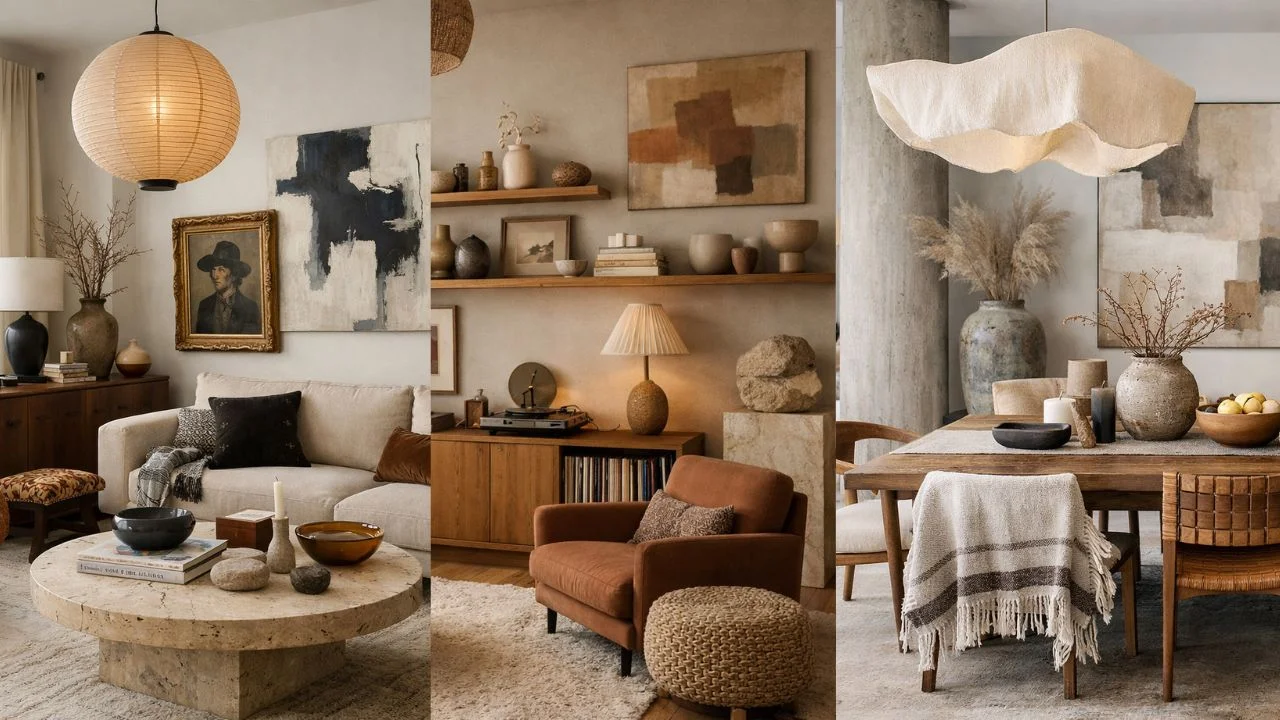
Maximalist interior design is often misunderstood as excess—but here, it unfolds differently. It is not loud or overwhelming. Instead, it feels grounded, warm, and deeply intentional.
In these spaces, maximalism becomes a quiet layering of texture, form, and material. Stone meets linen. Wood meets clay. Light softens everything. The result is not clutter, but a sense of fullness—a room that feels complete, lived-in, and quietly expressive.
1. Sculptural Foundations in Maximalist Interior Design
Maximalist interior design begins not with many objects, but with the right ones. A sculptural coffee table, a curved sofa, a grounded wooden stool—these pieces create the visual weight that holds the room together.

Instead of competing elements, there is a hierarchy. One strong form leads, while others follow softly.
Pro tip: Anchor the room with one dominant sculptural piece, then layer around it.
2. Layering Neutrals Within Maximalism
Maximalism doesn’t always rely on bold color. In these interiors, it thrives through tonal layering—cream beside sand, taupe beside clay.

The richness comes from variation in material rather than contrast in hue. This is where maximalist interior design becomes subtle yet deeply dimensional.
Pro tip: Stay within one color family but vary texture and tone for depth.
3. Earthy Accents as Emotional Warmth
In maximalist interior design, accents are not decorative—they are emotional. Rust, terracotta, and ochre tones introduce warmth in a way that feels natural and grounded.

These hues echo the outside world, connecting the interior to something more organic and timeless.
Pro tip: Let accent colors appear in small, repeated moments across the room.
4. The Art of Collected Maximalism
True maximalism is collected, not curated in a single moment. Objects feel gathered over time—vintage bowls, modern sculptures, worn books.
This layering creates depth not just visually, but emotionally. The room begins to tell a story.
Pro tip: Mix eras and finishes to create quiet contrast.
5. Architectural Softness and Flow
Arches, built-ins, and open transitions soften the structure of the space. They guide the eye gently, creating rhythm without sharp interruptions.
In maximalist interior design, architecture becomes part of the layering—not just a backdrop.
Pro tip: Use shelving or curtains to mimic architectural framing if needed.
6. Material-Led Maximalism
Stone, wood, linen, and ceramic are the foundation of this form of maximalism. Each material brings its own texture, weight, and presence.

Rather than relying on ornament, the beauty lies in authenticity—surfaces that feel real, slightly imperfect, and lived with.
Pro tip: Prioritize natural, matte materials over polished finishes.
7. Grounded Furniture and Low Profiles
Maximalist interior design often feels calm when furniture sits low and wide. This grounding effect creates a sense of stability.

It allows the layering above—decor, art, objects—to feel supported rather than overwhelming.
Pro tip: Keep key furniture pieces low to maintain visual calm.
8. Lighting That Blends Into the Atmosphere
Lighting in maximalism is not meant to stand out—it’s meant to soften. Linen shades, paper lanterns, and warm bulbs create a gentle glow.
This diffused light enhances texture, making every material feel richer and more tactile.
Pro tip: Avoid harsh overhead lighting—layer soft sources instead.

More on Maximalism
How to Style a Maximalist Home Using Memories, Art, and Travel Objects
Collected Maximalism: The Art of Composed Intensity
12 Types of Maximalism in Interior Design — And How to Use Them Intentionally
Collected vs Curated in Maximalist Interiors: Is There a Difference?
The Psychology of Maximalism: Emotional Density in Layered Interiors
Minimal Maximalism: Abundance Within Restraint
The Maximalist Way to Shop: How to Collect with Intention
9. Breathing Space Within Maximalism
Maximalism is not about filling every corner. Negative space is essential—it allows the eye to rest and the objects to stand out.

This balance is what separates intentional maximalist interior design from visual clutter.
Pro tip: Leave parts of surfaces intentionally empty.
10. A Seamless Connection to Nature
Maximalist interiors feel most complete when they connect to the outside. Light, greenery, and natural views extend the palette beyond the room.
Even a single branch or plant can soften the space and add life.
Pro tip: Introduce at least one organic element per room.
11. Designing Beyond Sight: The Sensory Side of Maximalism
Maximalist interior design is often understood through what we see—but its true depth lies in what we feel. Texture becomes the first language. Bouclé invites softness, stone holds quiet coolness, linen carries a gentle weight. These materials are not just visual layers; they create a tactile rhythm that makes the space feel lived rather than styled.
Beyond touch, the atmosphere is shaped by what lingers unseen. The faint warmth of wood, the softness of linen, the quiet presence of a candle. Even sound shifts—textiles absorb echoes, rugs soften footsteps, and the room begins to feel hushed, intimate.
Pro tip: Layer at least one soft textile, one natural material, and one ambient element (like scent or sound) to create a fully sensory space.
Shopping / Sourcing
- Sculptural stone or travertine coffee tables
- Bouclé or linen sofas
- Vintage wooden stools and side tables
- Handmade ceramic vases and bowls
- Layered neutral rugs
- Linen or paper lampshades
- Earth-toned cushions (rust, ochre, clay)
- Open wooden shelving
- Abstract or vintage wall art
- Decorative trays, books, and objects
10 Common Mistakes to Avoid in Earth Tone Maximalist Interior Design
1. Confusing maximalism with clutter
Without intention, layering becomes overwhelming rather than expressive.
2. Ignoring texture
Flat surfaces remove depth and richness.
3. Overusing bold color
Too much contrast can disrupt the calm tone of the space.
4. Matching everything
Uniformity removes the collected, lived-in feel.
5. Too many small objects
This creates visual noise instead of impact.
6. Lack of contrast
Even neutral spaces need variation in material and form.
7. Overloading one material
Too much of one element (like wood) can feel heavy.
8. Poor lighting
Harsh light breaks the softness of the design.
9. Filling every surface
Maximalism still needs breathing space.
10. Treating it like a trend
The best maximalist interiors evolve over time.
Conclusion
Maximalist interior design, at its most refined, is not about how much you add—but how thoughtfully you layer. It is a practice of attention. A quiet understanding of balance, weight, and space.
These interiors remind us that maximalism can feel calm. That fullness does not have to mean chaos. When materials are honest, tones are warm, and objects are chosen with care, a room begins to hold presence rather than noise.
In the end, maximalism is not a style you achieve in a single moment. It is something you build slowly—piece by piece, layer by layer—until the space feels like it could belong nowhere else but to you.
Video Featuring Neutral Boho Maximalism
10 FAQs About Maximalist Interior Design in Earth Tones
1. What is maximalist interior design?
Maximalist interior design focuses on layering textures, objects, and materials to create a rich, expressive space.
2. Can maximalism be neutral?
Yes, maximalism can exist within neutral palettes through texture and material variation.
3. How is maximalism different from clutter?
Maximalism is intentional and layered, while clutter lacks structure and balance.
4. What colors work best in maximalism?
Earth tones, warm neutrals, and muted accents work beautifully.
5. Is maximalism suitable for small spaces?
Yes, by focusing on fewer, larger pieces rather than many small items.
6. What materials define this style?
Wood, stone, linen, bouclé, and ceramics.
7. How do I start layering?
Begin with one anchor piece, then build around it gradually.
8. Do I need bold patterns?
No—texture can replace pattern in softer maximalist spaces.
9. How do I mix decor styles?
Combine vintage and modern pieces for balance.
10. What’s the key to successful maximalism?
Intentional layering and leaving space for the room to breathe.


