Introduction
Some rooms feel arranged. Others feel remembered.
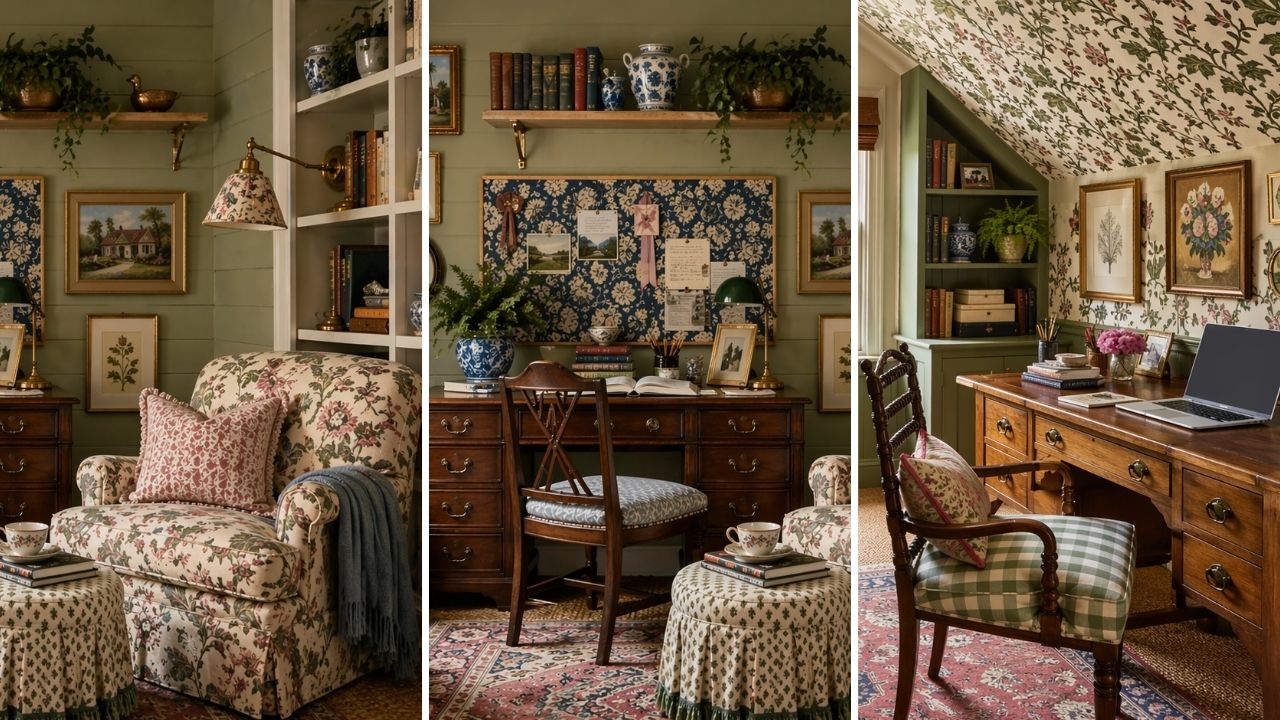
This English cottage style home office design belongs to the latter—a space where pattern, color, and objects settle into each other with quiet familiarity. It does not feel assembled in a moment, but gathered slowly, shaped by use and time.
Among timeless home office ideas, this approach stands apart. It is not driven by minimal efficiency, but by atmosphere. A workspace that invites you to stay longer, think slower, and notice more.
What makes this home office design truly work, however, is not just its charm. Beneath the layered florals and warm wood lies a clear structure—one that allows richness without chaos, and personality without clutter.
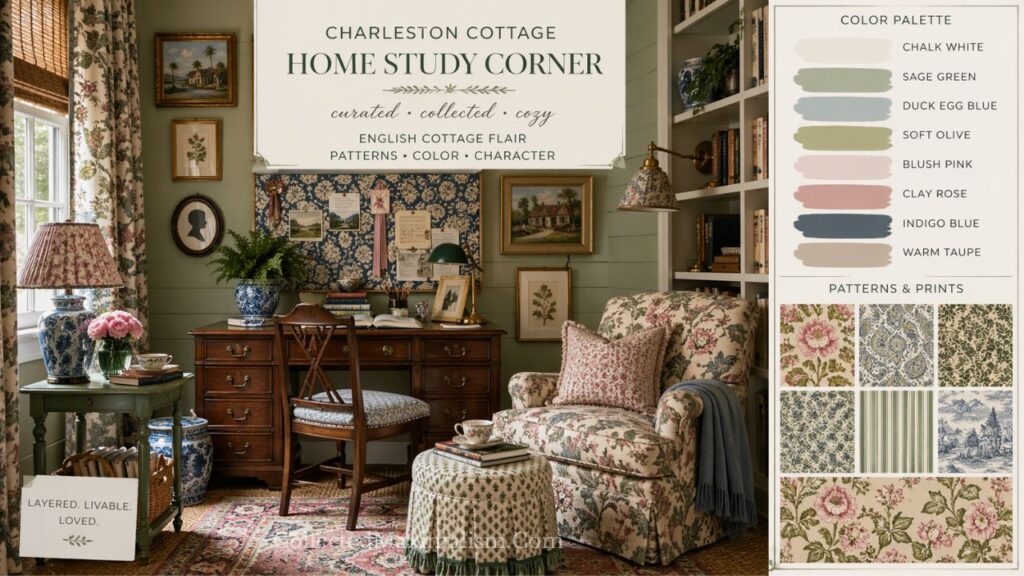
1. Pattern Hierarchy in Home Office Design
In English cottage style interiors, pattern is never random—it is guided. This home office design begins with a dominant floral wallpaper that defines the emotional tone of the space.
Because it holds visual authority, everything else becomes supporting. The chair upholstery, textiles, and smaller accents reduce in scale or contrast, allowing the room to feel layered rather than busy. This is what separates thoughtful home office design from decorative overload.
The result is a space where pattern feels immersive but never overwhelming—where the eye knows exactly where to begin, and how to move.
Pro tip: In any home office design, let one pattern lead and allow others to quietly support it.
2. Color Anchoring in English Cottage Style
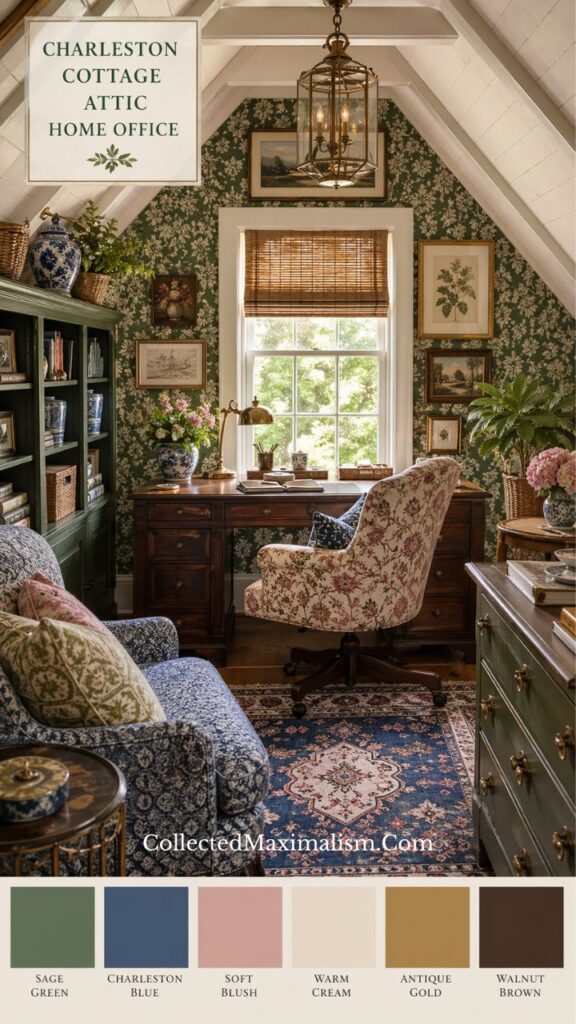
Color, in this English cottage style home office, acts as structure. Green is not simply decorative—it anchors the entire room.
From painted shelving to window trim and botanical elements, this recurring tone creates continuity. It allows softer hues—clay, blue, ivory—to exist freely without fragmenting the space. This is a key principle in successful home office design: cohesion through repetition.
The emotional effect is just as important. Green grounds the room, softening the richness of pattern and creating a calm environment ideal for focus.
Pro tip: Anchor your home office design with one recurring color across both furniture and architectural elements.
3. Furniture Weight Distribution in a Home Office
A well-balanced home office design considers not just placement, but visual weight. In this space, the desk acts as the horizontal anchor—solid, warm, and grounding.
The shelving introduces vertical presence, drawing the eye upward and adding structure. Meanwhile, the chair softens the composition with its lighter, woven form, preventing the space from feeling dense.
This balance is essential in English cottage style interiors, where richness must always be offset by lightness. Without it, the room would feel heavy instead of inviting.
Pro tip: Balance every solid piece in your home office with something visually lighter or more open.
4. Vertical vs Horizontal Layering in Home Office Design
Great home office design is not confined to surfaces—it moves through the entire room.
Horizontally, the desk carries daily objects—books, lighting, and small details that make the space feel lived-in. Vertically, shelving and wall art extend the visual field upward, adding depth and narrative.
This dual layering is what transforms simple home office ideas into immersive environments. It ensures the room feels complete from every angle, not just at desk level.
Without vertical layering, the space feels flat. Without horizontal presence, it feels disconnected. Together, they create balance.
Pro tip: When planning how to set up a home office, always think beyond the desk—layer the walls as intentionally as the surface.
5. Texture Contrast in English Cottage Style Interiors
Texture is what softens structure. In this English cottage style home office design, it prevents the layered patterns from becoming visually overwhelming.
Wood, fabric, ceramic, and woven elements each introduce a different tactile quality. The smoothness of ceramics contrasts with the softness of textiles, while natural fibers add irregularity and warmth.
This contrast allows the room to feel rich without relying solely on pattern. It adds depth that can be felt as much as seen—a key element in elevated home office design.
Pro tip: Combine at least three textures in every corner of your home office to create quiet depth.
6. Visual Rest Points in a Layered Home Office
Even the most layered home office design needs moments of pause.
In this space, rest points appear through negative space on shelves, the simplicity of the desk surface, and the softness of diffused lighting. These areas allow the eye to settle, preventing the room from feeling overwhelming.
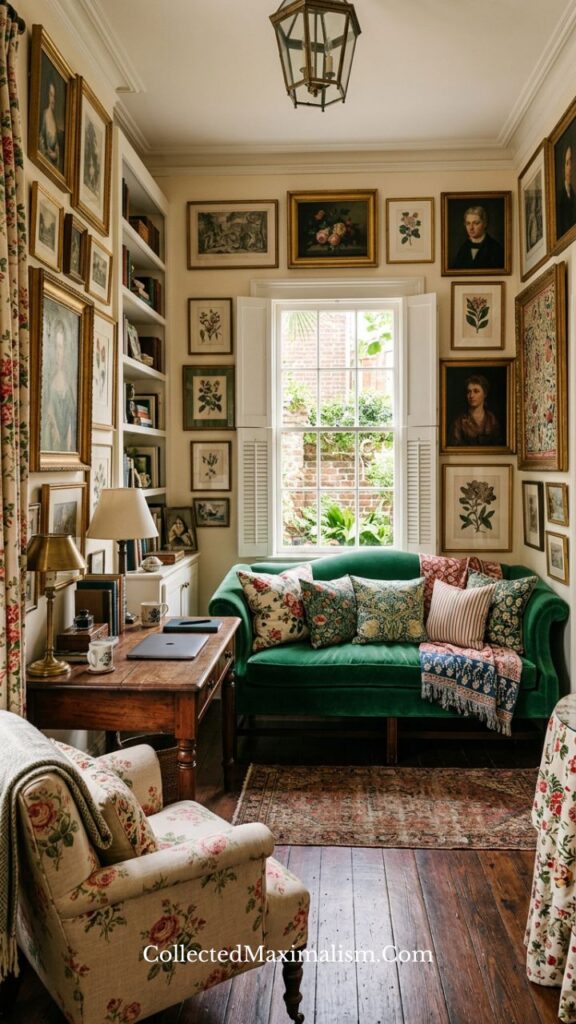
This is where many home office ideas fail—they focus on what to add, but not where to stop. In English cottage style, restraint is what makes richness sustainable.
A room that allows space will always feel more intentional than one that fills every corner.
Pro tip: When styling your home office, leave small areas untouched—visual quiet is part of the design.
More on Maximalism
8 Dining Table Decor Ideas | Romantic Dark Academia Maximalism
Light Fixtures in Maximalism: A Softer Approach to Layered Light
How to Style a Maximalist Home Using Memories, Art, and Travel Objects
Collected Maximalism: The Art of Composed Intensity
12 Types of Maximalism in Interior Design — And How to Use Them Intentionally
Collected vs Curated in Maximalist Interiors: Is There a Difference?
The Psychology of Maximalism: Emotional Density in Layered Interiors
Minimal Maximalism: Abundance Within Restraint
The Maximalist Way to Shop: How to Collect with Intention
Maximalist Interior Design: Layering Texture, Form, and Warm Earth Tones
10 Common Mistakes to Avoid in English Cottage Style Interiors
1. Ignoring pattern hierarchy
Without a dominant pattern, the space feels chaotic instead of layered.
2. Using too many colors without anchoring
A lack of repetition weakens cohesion and makes the palette feel disconnected.
3. Choosing overly heavy furniture
Too many solid pieces can make the space feel dense and uninviting.
4. Neglecting vertical space
Without height variation, the room feels flat and incomplete.
5. Overlooking texture contrast
Without varied materials, even beautifully styled spaces can feel one-dimensional.
6. Filling every surface
Clutter removes the calm, intentional feeling essential to this style.
7. Matching everything too perfectly
Over-coordination eliminates the collected charm that defines the look.
8. Using harsh lighting
Cool lighting disrupts the warmth and softness of the space.
9. Overscaling decor
Large pieces can overpower the balance of a layered interior.
10. Trying to finish too quickly
A truly collected space develops slowly, with time and intention.
Conclusion
A well-executed English cottage style home office design is not defined by how much it holds, but by how thoughtfully it is composed.
Each element—pattern, color, furniture, texture—works within a quiet system. Together, they create a space that feels layered but not overwhelming, personal but not cluttered. This is what elevates simple home office ideas into something lasting.
When you begin to approach your own home office design through these principles, the process becomes clearer. You are no longer just adding pieces—you are building relationships between them.
And over time, your space begins to reflect something deeper than style. It begins to feel lived, grounded, and entirely your own.
10 FAQs About Home Office Design in English Cottage Style
1. What defines English cottage style design?
It combines layered patterns, warm wood tones, and collected decor to create a space that feels timeless and lived-in.
2. How do I start an English cottage style space?
Begin with a dominant pattern or color, then layer supporting elements gradually.
3. What are the best ideas for small spaces?
Use vertical layering, light furniture, and a consistent color palette to avoid overcrowding.
4. How do I choose colors for this style?
Stick to a grounded palette with one anchor color repeated throughout the space.
5. What furniture works best in this look?
Wooden desks, woven chairs, and painted shelving create the right balance of structure and softness.
6. How do I balance function and beauty?
Choose practical pieces first, then layer decor gradually to maintain usability.
7. How important is lighting in this style?
Very—soft, warm lighting enhances texture and creates a calm, inviting atmosphere.
8. Can I mix modern elements into English cottage style?
Yes, but keep them minimal and balanced with traditional textures.
9. How do I make the space feel cozy but not cluttered?
Use pattern hierarchy, texture contrast, and visual rest points.
10. How long does it take to achieve a collected look?
It evolves over time—avoid rushing and allow the space to grow naturally.