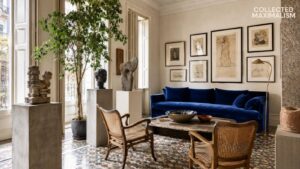
Maximalism has a reputation problem.
To some, it means layered richness and personality.
To others, it means visual chaos and too much “stuff.”
The confusion is understandable.
From a distance, maximalism and clutter can look similar: full shelves, art-covered walls, layered textiles, collected objects.
But look closer.
One is composed.
The other is uncontrolled.
Maximalism is intentional density.
Clutter is unfiltered accumulation.
The line between them is not quantity.
It is structure.
1. Intention vs. Impulse
Clutter accumulates through impulse.
Maximalism accumulates through intention.
In cluttered spaces, objects exist because they were never removed. In maximalist spaces, objects remain because they were chosen to stay.
Ask yourself:
Was this placed here deliberately?
Does it contribute to the room’s narrative?
Does it repeat a color, texture, or theme already present?
If the answer is no, you are likely looking at clutter.
Maximalism edits.
Clutter postpones editing.
2. Hierarchy vs. Equality
In cluttered rooms, everything competes equally.
No single piece holds authority.
No focal point guides the eye.
Everything asks for attention at once.
In maximalist rooms, hierarchy is clear.
There is an anchor — a large artwork, a statement sofa, a defined gallery wall. Secondary objects support that anchor. Background textures recede.
The eye knows where to land first.
Hierarchy is the dividing line.
3. Repetition vs. Randomness
Clutter is random.
Maximalism repeats.
In a composed maximalist interior, colors echo across surfaces. Materials reappear. Motifs subtly connect different parts of the room.
A brass frame relates to a brass lamp.
A terracotta tone reappears in a ceramic bowl.
A botanical theme surfaces in art and textiles.
Repetition creates cohesion.
Without repetition, abundance feels accidental.
4. Editing vs. Accumulation
Maximalism requires discipline.
Objects may be numerous, but they are curated. Surfaces may be layered, but they are refined.
Clutter resists removal.
Maximalism embraces subtraction.
One of the most important practices in a maximalist home is seasonal editing — rotating pieces, re-evaluating placement, removing what disrupts balance.
If nothing ever leaves, the room cannot evolve.
5. Breathing Space vs. Compression
Clutter eliminates negative space.
Every surface is filled. Every wall is covered. Every table is crowded.
Maximalism understands contrast.
Even in dense interiors, there are pauses:
A stretch of wall between frames.
An open portion of a coffee table.
A clear corner beside a layered console.
Negative space amplifies richness.
Without pause, density becomes noise.
6. Emotional Weight vs. Visual Noise
Clutter often feels overwhelming because it lacks emotional hierarchy.
Objects may hold memory, but they are not organized by meaning.
Maximalism, at its core, is emotional authorship.
Objects remain visible because they matter. They carry story. They represent identity.
If you cannot explain why something is there — it may not belong.
Maximalism is narrative-driven.
Clutter is storage without structure.
7. Architecture vs. Surface
Clutter ignores architecture.
It piles onto surfaces without responding to the room’s structure.
Maximalism responds to architecture.
Gallery walls align with furniture width.
Layering respects ceiling height.
Furniture placement anchors density.
The room remains readable.
Clutter obscures structure.
Maximalism reinforces it.
8. Confidence vs. Anxiety
There is also a psychological distinction.
Clutter often produces low-level anxiety. The eye moves constantly. Nothing resolves.
Maximalism, when done well, feels grounding.
It feels immersive rather than overwhelming. The room holds you rather than agitates you.
If a space feels chaotic rather than layered, the issue is not quantity — it is composition.
9. When Maximalism Becomes Clutter
The line is crossed when:
- There is no dominant focal point.
- Objects are added without removing others.
- Color repetition disappears.
- Scale variation is ignored.
- Negative space vanishes.
At that moment, intention has given way to accumulation.
The solution is not minimalism.
The solution is structure.
More on Maximalism
How to Style a Maximalist Home Using Memories, Art, and Travel Objects
Collected Maximalism: The Art of Composed Intensity
12 Types of Maximalism in Interior Design — And How to Use Them Intentionally
Collected vs Curated in Maximalist Interiors: Is There a Difference?
The Psychology of Maximalism: Emotional Density in Layered Interiors
The Line Is Not Minimalism
The answer to clutter is not emptiness.
It is clarity.
Maximalism is not the opposite of discipline. In fact, it demands more of it.
To layer well requires:
- Awareness of scale
- Repetition of tone
- Careful editing
- Architectural alignment
- Emotional clarity
When these principles are present, abundance feels composed.
When they are absent, abundance collapses into clutter.
Editing: The Discipline Behind Density
This is where maximalism separates itself from clutter.
Editing is not the opposite of maximalism. It is its backbone.
To edit in a maximalist home does not mean removing personality. It means refining it. It means deciding what deserves visibility — and what does not.
Editing asks:
- Does this object support the room’s dominant lens?
- Does it repeat a tone, texture, or narrative already present?
- Does it add visual weight — or only distraction?
- If I removed it, would the room feel clearer?
A maximalist space should feel layered, not compressed.
When every object is allowed to remain without evaluation, the room loses hierarchy. But when editing is practiced intentionally, density sharpens. The most meaningful pieces begin to breathe.
Without editing, maximalism drifts into accumulation.
With editing, maximalism becomes composition.
The most powerful maximalist interiors are not the fullest.
They are the most deliberate.
Visual Rest: Why Pause Strengthens Abundance
Maximalism is not a constant crescendo.
Even the most layered room requires pause.
Visual rest is the quiet space between clusters — the stretch of wall between frames, the exposed surface of a coffee table, the negative space beside a sculptural object.
These moments are not emptiness.
They are contrast.
Without pause, density becomes noise. The eye searches without resolution. With pause, the eye travels intentionally.
Maximalism thrives on rhythm — density followed by calm, statement followed by softness.
Abundance feels richest when it is framed.
The Role of Time: Why True Maximalism Evolves Slowly
Clutter often happens quickly.
Objects accumulate without intention, purchases are made impulsively, surfaces fill faster than they are refined.
Maximalism, when practiced well, evolves slowly.
It grows through:
- Collected art
- Traveled memories
- Inherited pieces
- Gradual layering
- Intentional shifts
Time creates cohesion.
A room that develops over seasons feels different from a room styled in a weekend. It carries maturity. It reflects lived experience rather than aesthetic urgency.
True maximalism is patient.
It allows the home to reveal itself gradually.
When Others Call It “Too Much”
Not everyone understands maximalism.
Some people feel calm in blank walls and open surfaces. Others feel safe in layered spaces and visual richness.
If someone walks into your home and says,
“Oh my God, there’s so much going on,”
that does not mean you have failed.
It means they are wired differently.
Maximalism is deeply personal. It reflects memory, story, identity, and emotional preference.
You are the one who lives there.
You are the one who wakes up in the space.
You are the one who feels its atmosphere daily.
The only question that matters is:
How do you feel inside your own room?
If you feel grounded, inspired, and at ease, then the composition is working.
Maximalism is not about approval.
It is about alignment.
A Reflection Exercise: Step Into Your Room
Before rearranging anything, pause.
Stand in the center of your living room.
Look around slowly.
Ask yourself:
- Where does my eye land first?
- Where does it feel restless?
- Which objects feel essential?
- Which feel unresolved?
- Do I feel calm, inspired, overwhelmed, or energized?
Describe the room in three words.
Then remove one object.
Step back again.
Notice the shift.
You do not need to redesign your space to understand it.
You need to observe it honestly.
Style clarity begins with awareness.
10 Common Mistakes That Turn Maximalism Into Clutter
1. Adding Without Removing
When objects are only added and never edited, structure collapses.
2. Ignoring Focal Points
Without a visual anchor, density becomes competition.
3. Treating Every Object as Equal
Maximalism requires hierarchy. Clutter does not.
4. Forgetting Repetition
If colors and materials don’t echo across the room, layering feels random.
5. Eliminating Negative Space
Every surface filled equals visual noise.
6. Mixing Too Many Scales Without Balance
Too many small objects fragment a room.
7. Over-Collecting in One Area
When shelves become storage instead of composition, clarity disappears.
8. Decorating Emotionally Without Structure
Sentimental objects still require thoughtful placement.
9. Ignoring Architecture
Maximalism responds to walls, ceilings, and layout. Clutter ignores them.
10. Refusing to Edit
Editing is not minimalism. It is refinement.
Final Thought: Density with Decision
Maximalism is not about more.
It is about meaning.
Clutter is not about more either.
It is about lack of decision.
The line between them is drawn every time you choose deliberately rather than impulsively.
In a maximalist home, every object answers a question:
Why am I here?
If the answer is clear, the room is composed.
If the answer is absent, it is time to edit.
That is where the line lives.
10 Frequently Asked Questions About Maximalism vs Clutter
1. How do I know if my space is cluttered or maximalist?
If your eye cannot find a focal point, it may be clutter. If hierarchy is clear, it’s maximalism.
2. Can a small room be maximalist without looking messy?
Yes. Focus on vertical layering and strong anchors rather than overcrowding.
3. Does maximalism require lots of objects?
No. It requires layered impact, not sheer quantity.
4. How often should I edit a maximalist room?
Seasonally or whenever balance feels disrupted.
5. Is clutter always bad?
Clutter becomes problematic when it disrupts calm and cohesion.
6. Can sentimental items cause clutter?
Yes, if they are not grouped or integrated intentionally.
7. What is the fastest way to fix clutter?
Remove the smallest unnecessary items first and reestablish hierarchy.
8. Should maximalism look busy?
Layered, yes. Busy, no. The difference lies in repetition and structure.
9. Is minimalism the solution to clutter?
Not necessarily. Structure, editing, and clarity are the solutions.
10. What is the core difference in one sentence?
Maximalism is intentional abundance. Clutter is unintentional accumulation.