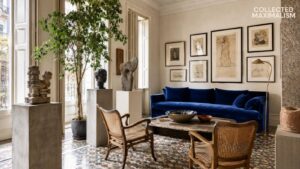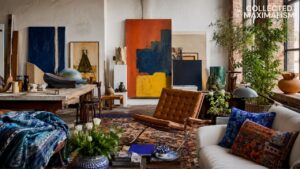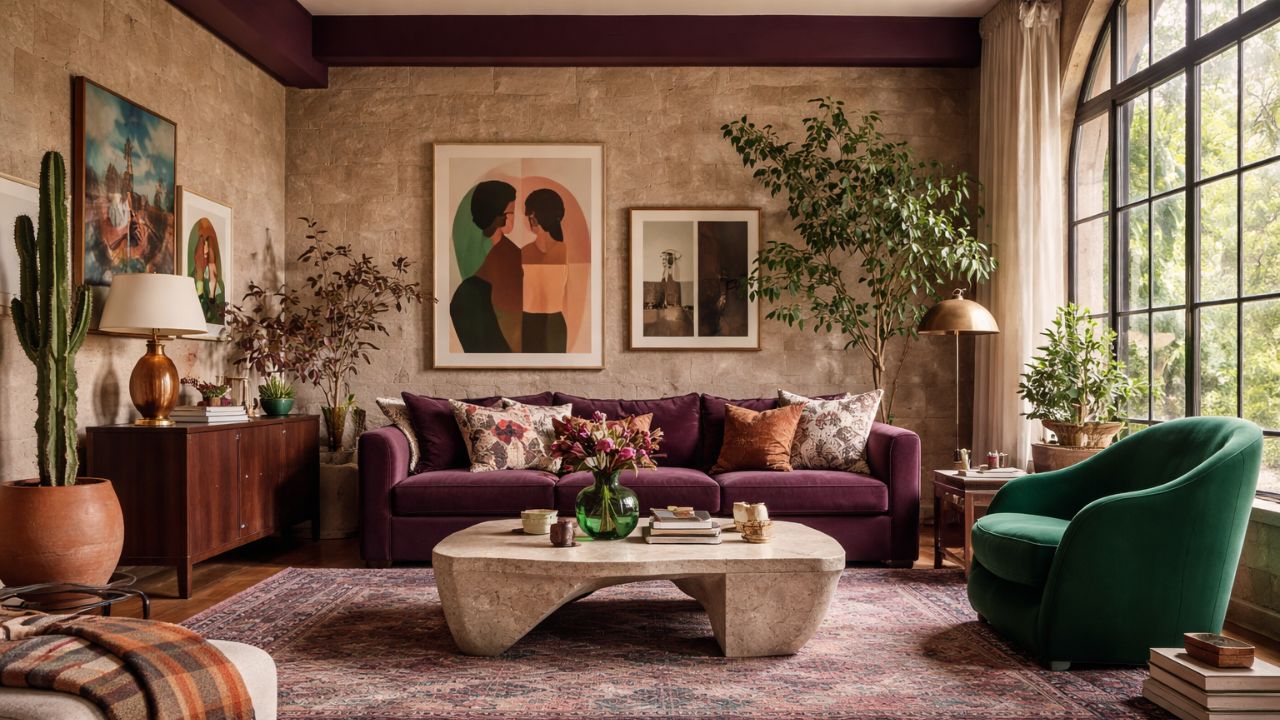
Maximalism is not a trend.
It is not a formula.
It is not a shopping list.
It is a language.
But within that language, every maximalist speaks differently.
Some are drawn to moody depth and velvet shadows.
Others crave sunlit plaster walls and Mediterranean warmth.
Some layer vintage nostalgia and portraiture.
Others compose bold modern contrast with sculptural clarity.
To discover your style as a maximalist is not to choose a category.
It is to recognize your dominant voice within abundance.
Here is how to define it with clarity.
1. Observe What You Are Naturally Drawn To
Your style already exists.
Look at your saved images.
Your Pinterest boards.
Your camera roll.
The rooms you linger over.
The corners you photograph.
Ask yourself:
- Do I consistently gravitate toward dark and intimate spaces?
- Do I prefer rooms filled with books and art?
- Do I love bold color contrast?
- Do I feel most at ease in light, layered interiors?
Patterns reveal preference.
Maximalism begins with instinct, not intention.
2. Identify What Feels Like Home — Not What Impresses You
It is easy to admire a room without belonging in it.
A richly layered Victorian library may impress you.
A bold color-driven space may energize you.
But which one feels like you?
Style is not about admiration. It is about alignment.
Ask:
Where would I feel calm?
Where would I host?
Where would I think clearly?
Where would I rest?
Your emotional reaction is more honest than aesthetic preference.
3. Notice What You Collect Without Thinking
Maximalists reveal themselves through accumulation.
Look at what you purchase repeatedly:
- Portrait art?
- Ceramic vessels?
- Linen textiles?
- Books?
- Brass objects?
- Sculptural furniture?
You do not collect randomly.
You collect according to internal resonance.
Your repeated objects are clues.
4. Determine Your Dominant Element
Every maximalist style has a leading force.
For some, it is color.
For others, it is architecture.
For others, it is art.
For others, texture.
Ask:
If I had to remove everything but one design element, what would I protect first?
That answer defines your foundation.
Once you know your dominant element, your layering becomes clearer.
5. Understand the Different Maximalist Lenses
Maximalism expresses itself in many forms:
- Modern
- Moody
- Architectural
- Classic
- Vintage
- Romantic European
- Coastal
- Bohemian
- Color-Driven
- Eclectic Global
- Artistic
- Minimalist Maximalism
You do not need to choose one permanently.
But you will feel a natural gravity toward one or two.
That gravity matters.
6. Accept That Blending Is Natural — But Hierarchy Is Essential
Most maximalist homes are layered blends.
You may be:
Modern with moody undertones.
Classic with romantic softness.
Architectural with color-driven accents.
Blending is not confusion.
But one voice must lead.
Without hierarchy, rooms feel scattered.
With hierarchy, they feel intentional.
Define your primary lens.
Let others support it.
7. Clarify Your Non-Negotiables
Your style becomes clear when you define what you will not remove.
Ask yourself:
- Will there always be books in my living room?
- Will I always prefer textured fabrics?
- Will I always gravitate toward deep tones?
- Will I always need art on my walls?
Non-negotiables anchor identity.
Everything else rotates around them.
8. Separate Influence from Imitation
It is natural to be inspired by designers, films, and curated interiors.
But style develops when you extract principles — not aesthetics.
Instead of copying:
- Extract the color logic.
- Extract the scale variation.
- Extract the lighting mood.
- Extract the hierarchy.
Imitation creates sameness.
Interpretation creates authorship.
9. Let Your Style Evolve Seasonally
Maximalism is not static.
Spring softens.
Summer brightens.
Autumn deepens.
Winter intensifies.
Your style will adjust in tone without losing its core.
Evolution does not mean inconsistency.
It means maturity.
10. Define Your Style in a Sentence
If you can articulate your style in one sentence, you understand it.
For example:
“I lean toward architectural maximalism with soft Mediterranean warmth.”
Or:
“My style is classic and art-driven, with moody undertones.”
Or:
“I prefer modern structure layered with vintage narrative.”
This clarity becomes your filter.
It guides purchases.
It refines edits.
It strengthens confidence.
More on Maximalism
How to Style a Maximalist Home Using Memories, Art, and Travel Objects
Collected Maximalism: The Art of Composed Intensity
12 Types of Maximalism in Interior Design — And How to Use Them Intentionally
Collected vs Curated in Maximalist Interiors: Is There a Difference?
The Psychology of Maximalism: Emotional Density in Layered Interiors
Minimal Maximalism: Abundance Within Restraint
A Practical Exercise: Train Your Eye Before You Redesign
Understanding your maximalist style does not happen overnight.
It happens through observation.
Create a new Pinterest board and name it something simple — Your Home. You can keep it private if you prefer. This is not for performance. It is for clarity.
For the next month — or even two — begin saving images instinctively.
Not strategically.
Not analytically.
Not based on what you think you “should” like.
Simply save the living rooms, bedrooms, dining tables, coffee tables, and corners that make you pause.
Do this consistently.
Then step away.
After several weeks, return and study your own board.
Patterns will begin to reveal themselves.
You may notice:
- You consistently save darker rooms with layered lighting.
- Or you gravitate toward sunlit spaces with plaster walls.
- Or bold color combinations repeat across pins.
- Or you favor portrait art over abstract pieces.
- Or woven textures appear again and again.
You will not suddenly “realize” your style.
You will see it emerging.
That distinction matters.
This exercise removes pressure. It allows your instinct to surface without forcing definition too quickly.
Maximalist style is not chosen in a single moment. It reveals itself through repetition.
When you observe your own visual patterns without judgment, your dominant lens becomes clear.
And once you see it, you cannot unsee it.
Video on What is Maximalism in Interior Design
10 Common Mistakes to Avoid When Defining Your Maximalist Style
Discovering your style requires clarity, not impulse. Here are the most common missteps to avoid when defining yourself as a maximalist.
1. Confusing Maximalism with Clutter
Maximalism is structured abundance. Without hierarchy, repetition, and intentional layering, density becomes visual noise rather than identity.
2. Copying Aesthetic Trends Instead of Identifying Instinct
Admiring a room does not mean it reflects you. Your style should emerge from emotional comfort, not algorithm-driven inspiration.
3. Trying to Embody Every Maximalist Lens at Once
Modern, moody, romantic, coastal — blending is natural, but one lens must lead. Without dominance, your style feels scattered rather than composed.
4. Ignoring Emotional Response
Style is emotional before it is visual. If a space looks impressive but feels unsettling, it is not aligned with you.
5. Collecting Without Editing
Maximalism still requires curation. Keeping everything prevents clarity from forming and weakens narrative strength.
6. Mistaking Volume for Personality
More objects do not equal stronger identity. Repetition and cohesion create authorship.
7. Redesigning Too Quickly
Style develops over time. Constant reinvention prevents depth and maturity from forming.
8. Over-Labeling Yourself
You do not need to permanently define yourself as “moody” or “modern.” Allow evolution within structure.
9. Ignoring Architectural Context
Your maximalist style must respond to your home’s architecture. Forcing an aesthetic against structural reality weakens cohesion.
10. Seeking Validation Instead of Alignment
If your choices are made to impress rather than resonate, your style will feel unstable and performative.
Maximalism as Self-Knowledge
To discover your style as a maximalist is to understand what you value.
Maximalism is not about having more.
It is about keeping what resonates deeply enough to stay visible.
When you recognize your dominant lens, your emotional triggers, your non-negotiables, and your natural patterns, maximalism becomes easier.
You stop second-guessing.
You stop imitating.
You start composing.
And that is where personal style begins.
10 Frequently Asked Questions About Discovering Your Maximalist Style
1. How do I know if I’m truly a maximalist?
If you feel comfort in layered spaces, enjoy visual richness, and resist emptiness, you likely lean toward maximalism.
2. Can I like minimalism and still be a maximalist?
Yes. Many maximalists appreciate structure and restraint within density. Minimalist maximalism exists.
3. How many styles can I blend?
You can blend multiple influences, but one should dominate to maintain clarity and hierarchy.
4. What if my taste keeps changing?
Evolution is natural. Identify your consistent non-negotiables — those rarely shift dramatically.
5. How do I define my dominant lens?
Observe repetition in what you save, purchase, and respond to emotionally. Patterns reveal identity.
6. Is maximalism expensive to achieve?
Not necessarily. Maximalism often grows through collected objects, vintage finds, and layered accumulation over time.
7. What’s the difference between eclectic and maximalist?
Eclectic refers to mixed influences. Maximalism refers to density and layering with intentional structure.
8. Should my entire home reflect one style?
Consistency matters, but rooms can vary slightly in tone as long as the overall narrative remains cohesive.
9. How do I avoid feeling overwhelmed by my own decor?
Prioritize hierarchy, repetition, and editing. Overwhelm usually signals lack of structure, not too much personality.
10. When does maximalism become too much?
When the eye has nowhere to rest. Pause, edit, and reestablish visual anchors.