Introduction
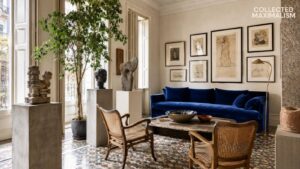
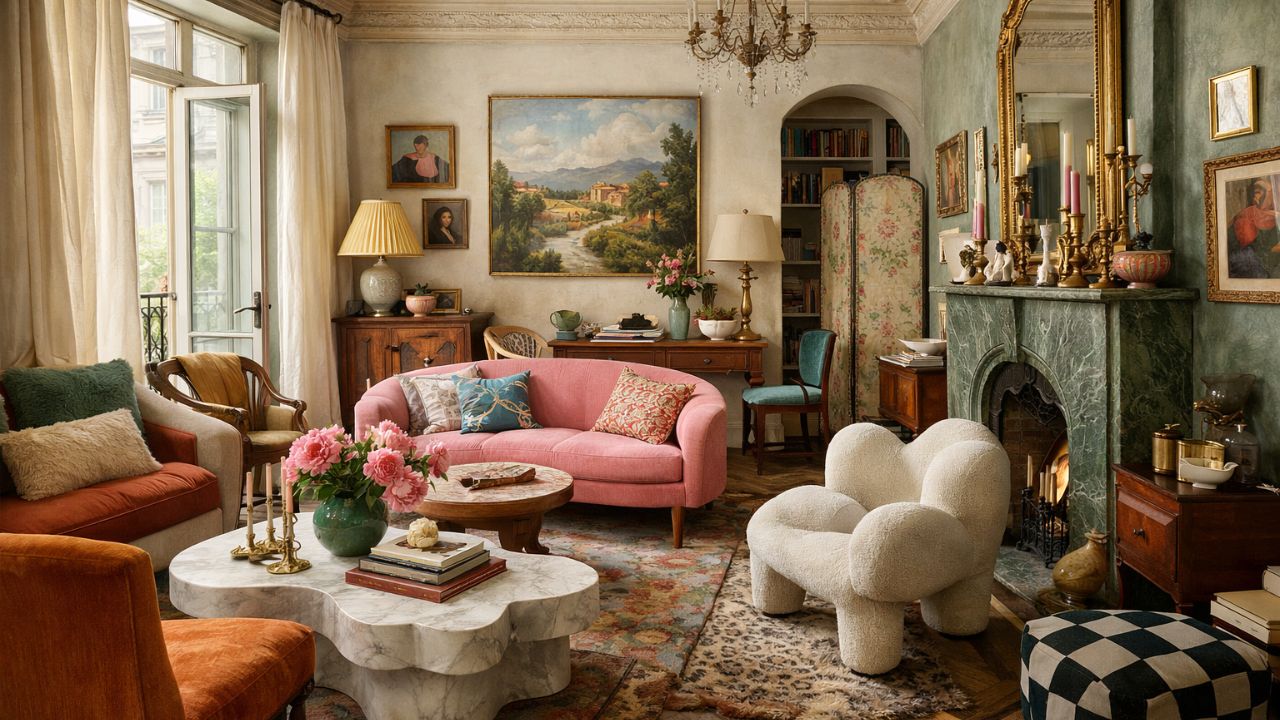
European heritage maximalism interiors combine classic European design with layered, collected styling to create spaces that feel rich, storied, and deeply personal.
There’s a certain poetry to spaces that feel lived-in, storied, and deeply personal.
A room where velvet drapes fall heavily against tall windows, where gilded mirrors reflect soft candlelight, and where every object feels like it has a past—this is the essence of European heritage maximalism interiors.
It is not about excess for the sake of it. It is about curation. About layering history, texture, and emotion in a way that feels rich, intentional, and quietly opulent.
In a world that often leans toward minimalism, this style invites you to embrace depth—to create a home that feels collected over time rather than assembled in a day.
What Defines European Heritage Interiors
At its core, European heritage maximalism interiors are rooted in tradition, yet styled with a modern sense of confidence.
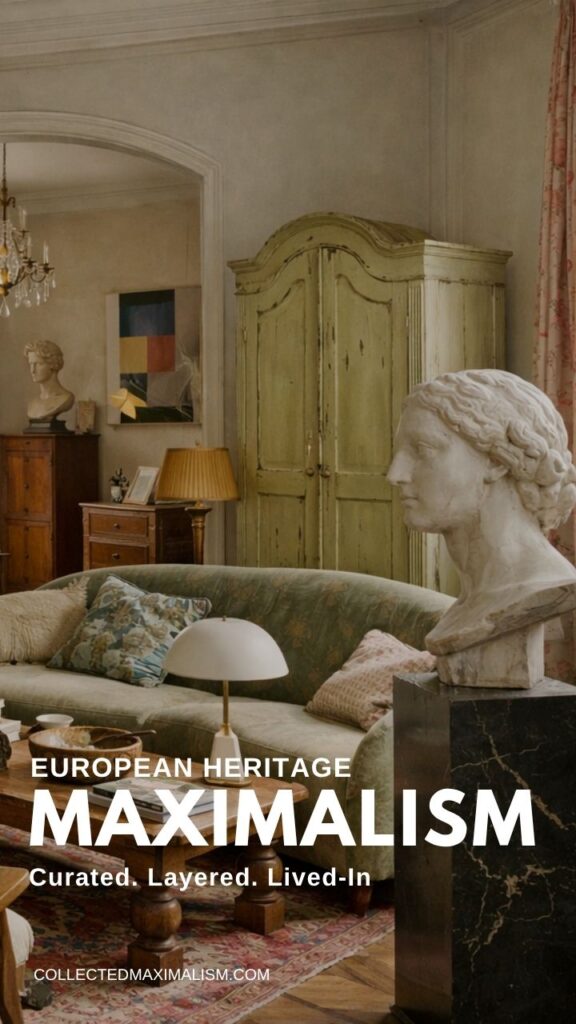
This aesthetic draws from centuries-old European design—French châteaux, English manors, Italian villas—blending ornate detailing with layered composition.
Think carved wood furniture, intricate moldings, antique finishes, and rooms that feel full yet harmonious.
Unlike chaotic maximalism, this approach is deeply refined. Every piece has purpose. Every layer adds meaning.
It is less about “more” and more about meaningful abundance.
The Art of Layering: Where Maximalism Comes Alive
Layering is the heartbeat of this design philosophy.
Start with a base—neutral walls, perhaps in soft ivory or muted taupe. Then begin to build:
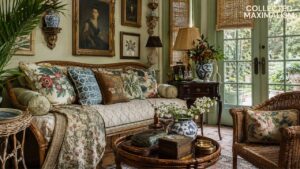
- A vintage rug with faded florals
- A velvet armchair in a jewel tone
- An antique console with patina
- Stacks of books, aged and textured
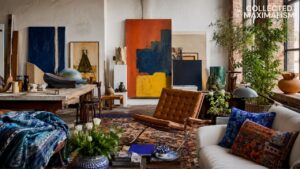
In European heritage maximalism interiors, nothing feels flat. There is always depth—visual, tactile, emotional.
Textures overlap. Patterns converse. Materials contrast.
The result is a space that feels immersive, almost cinematic.
Rich Materials That Tell a Story
Materials are what give this style its unmistakable richness.
Velvet, silk, brocade, and linen create softness and movement. Dark woods—walnut, mahogany, oak—anchor the space with warmth and history.
Marble surfaces add a quiet coolness, while aged metals like brass and gold bring in a soft, time-worn glow.
These are not just materials—they are storytellers.
In European heritage interiors, nothing feels new in a stark way. Even new pieces are chosen for how beautifully they can age.
Color Palettes: Deep, Muted, and Romantic
Color plays a transformative role in European heritage maximalism interiors.
Rather than bright or overly saturated tones, this style leans into depth:
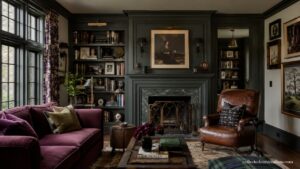
- Deep emerald greens
- Dusty rose and muted blush
- Rich burgundy and wine
- Antique gold and warm neutrals
These shades create a cocooning effect—rooms that feel intimate, enveloping, and softly dramatic.
Layering similar tones adds sophistication, while subtle contrast keeps the space dynamic.
Furniture with Character and Craftsmanship
In European heritage maximalism interiors, furniture is never generic.
Each piece feels chosen—often antique or vintage-inspired—with intricate detailing that speaks of craftsmanship.
Curved legs, carved edges, tufted upholstery, and inlaid wood bring dimension and personality.
Mixing styles is part of the charm. A Louis-style chair might sit beside a rustic wooden table. A gilded mirror might hang above a simple linen sofa.
It’s this blend that creates authenticity.
Decor That Feels Collected, Not Styled
Accessories in this aesthetic are deeply personal.
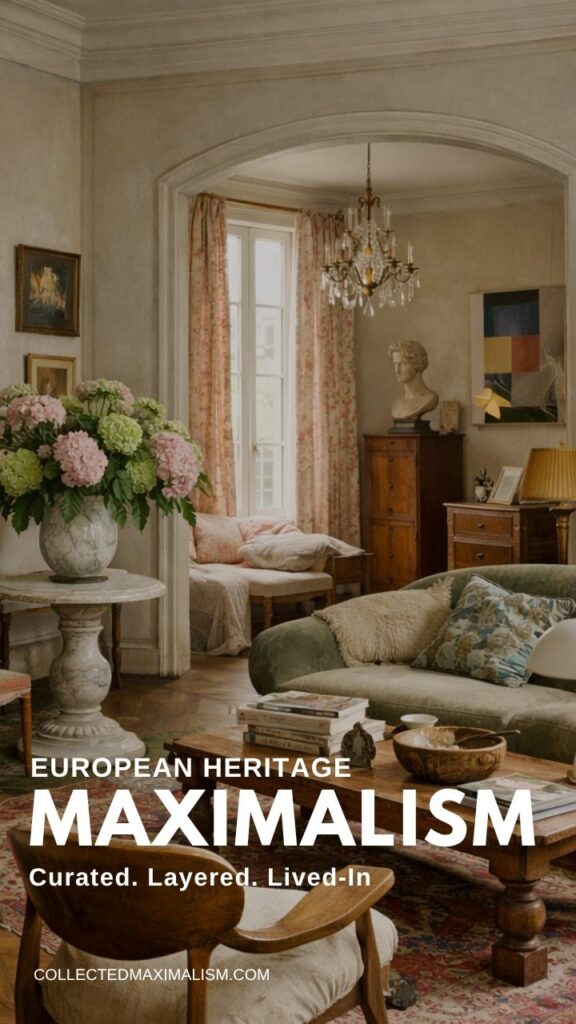
Framed art—often classical or portrait-style—lines the walls. Candle holders, ceramic vases, and sculptural objects are layered thoughtfully across surfaces.
Books are not hidden—they are displayed, stacked, and lived with.
In European heritage maximalism interiors, perfection is not the goal. Presence is.
The space should feel like it has evolved—like each object arrived at a different moment in time.
The Role of Lighting: Soft, Golden, Atmospheric
Lighting in this style is never harsh.
Instead, it is warm, diffused, and atmospheric. Think chandeliers with soft bulbs, table lamps with fabric shades, and the gentle flicker of candles.
Light interacts with textures—catching on gold frames, reflecting off glass, softening heavy fabrics.
It creates mood. It creates intimacy.
And most importantly, it makes the space feel alive.
Why European Heritage Maximalism Interiors Endure
Unlike trend-driven interiors, European heritage maximalism interiors are rooted in permanence.
They reject the idea of fast decor and instead embrace pieces that age beautifully over time.
This style reflects a deeper cultural philosophy—one that values history, craftsmanship, and emotional connection to space.
Because of this, these interiors never feel outdated. They evolve.
Each layer added over time strengthens the narrative rather than disrupting it.
It is this sense of continuity that gives the style its enduring appeal.
Key Pieces That Define European Heritage Maximalism Interiors
To bring this aesthetic into your home, focus on a few foundational elements:
- A vintage or antique-style mirror with a gilded frame
- Velvet seating in deep, muted tones
- A richly patterned rug with a worn-in look
- Antique brass or gold-toned decor accents
- Classic artwork in ornate frames
- Layered textiles such as throws and cushions
These pieces don’t need to be collected all at once. Start with one or two, and build gradually.
European heritage maximalism interiors are defined not by quantity, but by intention.
More on Maximalism
How to Style a Maximalist Home Using Memories, Art, and Travel Objects
Collected Maximalism: The Art of Composed Intensity
12 Types of Maximalism in Interior Design — And How to Use Them Intentionally
Collected vs Curated in Maximalist Interiors: Is There a Difference?
The Psychology of Maximalism: Emotional Density in Layered Interiors
Minimal Maximalism: Abundance Within Restraint
The Maximalist Way to Shop: How to Collect with Intention
Bringing the Look Into Modern Homes
You don’t need a historic estate to embrace this style.
Start small:
- Introduce one antique or vintage-inspired piece
- Layer textiles—throws, cushions, rugs
- Add framed art or a statement mirror
- Incorporate warm lighting
Gradually, your space will begin to feel more layered, more personal, more you.
European heritage maximalism interiors are not about instant transformation—they are about evolution.
10 Common Mistakes to Avoid in European Maximalism Interiors
1. Confusing Maximalism with Clutter
European heritage interiors is not about filling every space.
It’s about intentional layering.
When objects are added without purpose or cohesion, the space begins to feel chaotic rather than curated.
Fix:
Edit your space. Every piece should contribute to the story.
2. Ignoring Historical Influence
European heritage interiors is rooted in heritage design—French, Italian, and English interiors.
Without this foundation, the space loses authenticity.
Fix:
Incorporate elements like:
- antique-style furniture
- classical art
- traditional silhouettes
3. Using Too Many Unrelated Colors
Color in this style is rich but controlled.
Too many competing shades create visual noise instead of depth.
Fix:
Stick to a tight, layered palette:
- 2–3 dominant tones
- 1–2 accent shades
4. Choosing Pieces That Look Too New
European heritage interiors thrives on patina and age.
Overly modern, polished items can break the illusion.
Fix:
Look for:
- vintage finishes
- distressed textures
- antique-inspired designs
5. Overcrowding Without Negative Space
Even the most layered interiors need breathing room.
Without it, the eye has nowhere to rest.
Fix:
Leave small areas intentionally open to balance richness with restraint.
6. Ignoring Texture Variation
Flat interiors kill the richness of maximalism.
If everything feels the same, the space loses depth.
Fix:
Layer contrasting textures like velvet, linen, wood, marble, and metal.
7. Matching Everything Too Perfectly
Perfect coordination makes a space feel staged.
European maximalism embraces collected contrast.
Fix:
Mix styles, eras, and materials to create authenticity.
8. Neglecting Lighting Atmosphere
Harsh lighting disrupts the entire aesthetic.
This style depends on warm, layered lighting.
Fix:
Use table lamps, warm bulbs, and candles to create softness.
9. Overlooking the Importance of Art
Art is foundational in European heritage interiors.
Bare walls make the space feel incomplete.
Fix:
Add classical paintings, portraits, or framed sketches.
10. Trying to Achieve the Look Too Quickly
This style is not meant to be created overnight.
It evolves over time.
Fix:
Collect slowly. Let your space build naturally and meaningfully.
Closing
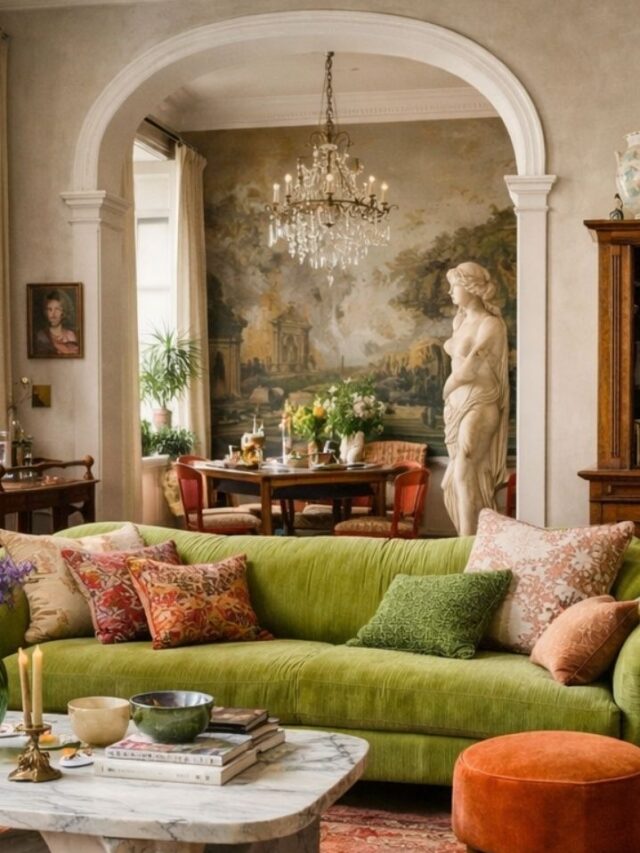
There is something deeply comforting about a home that feels rich with story.
A space that doesn’t just look beautiful, but feels meaningful. Where every corner holds a detail, and every detail holds intention.
European heritage interiors invite you to slow down—to collect, to curate, to surround yourself with things that resonate.
Because true luxury isn’t found in emptiness.
It’s found in layers, in history, and in the quiet beauty of a home that tells your story.
FAQs: European Maximalism Interiors
What is European heritage in interior design?
European maximalism is a layered interior style inspired by traditional European homes, combining antiques, rich textures, and curated decor to create a space that feels storied and personal.
How is European maximalism different from regular maximalism?
European maximalism is more refined and historically influenced, while general maximalism can sometimes be more eclectic or trend-driven.
Can European heritage interiors work in small spaces?
Yes, it can work beautifully in small spaces when layering is done thoughtfully and balanced with negative space.
What colors work best for European heritage interiors?
Deep, muted tones like emerald green, burgundy, dusty rose, and warm neutrals work best to create a rich and cohesive look.
Do I need antiques for this style?
Authentic antiques help, but you can also use vintage-inspired pieces that mimic aged finishes and classic craftsmanship.
How do I avoid making this style look messy?
Focus on intentional placement, cohesive colors, and balanced layering instead of adding too many unrelated elements.
What kind of lighting suits European maximalism interiors?
Warm, ambient lighting such as table lamps, chandeliers, and candles enhances the depth and atmosphere of the space.
Is European heritage interiors expensive to achieve?
It doesn’t have to be. You can build the look slowly over time by mixing affordable pieces with vintage finds.
Can I mix modern elements into European heritage interiors?
Yes, but they should be balanced with traditional elements so the space still feels rooted in heritage.
How long does it take to achieve this style?
European heritage interiors is meant to evolve over time. The best spaces feel collected rather than instantly styled.